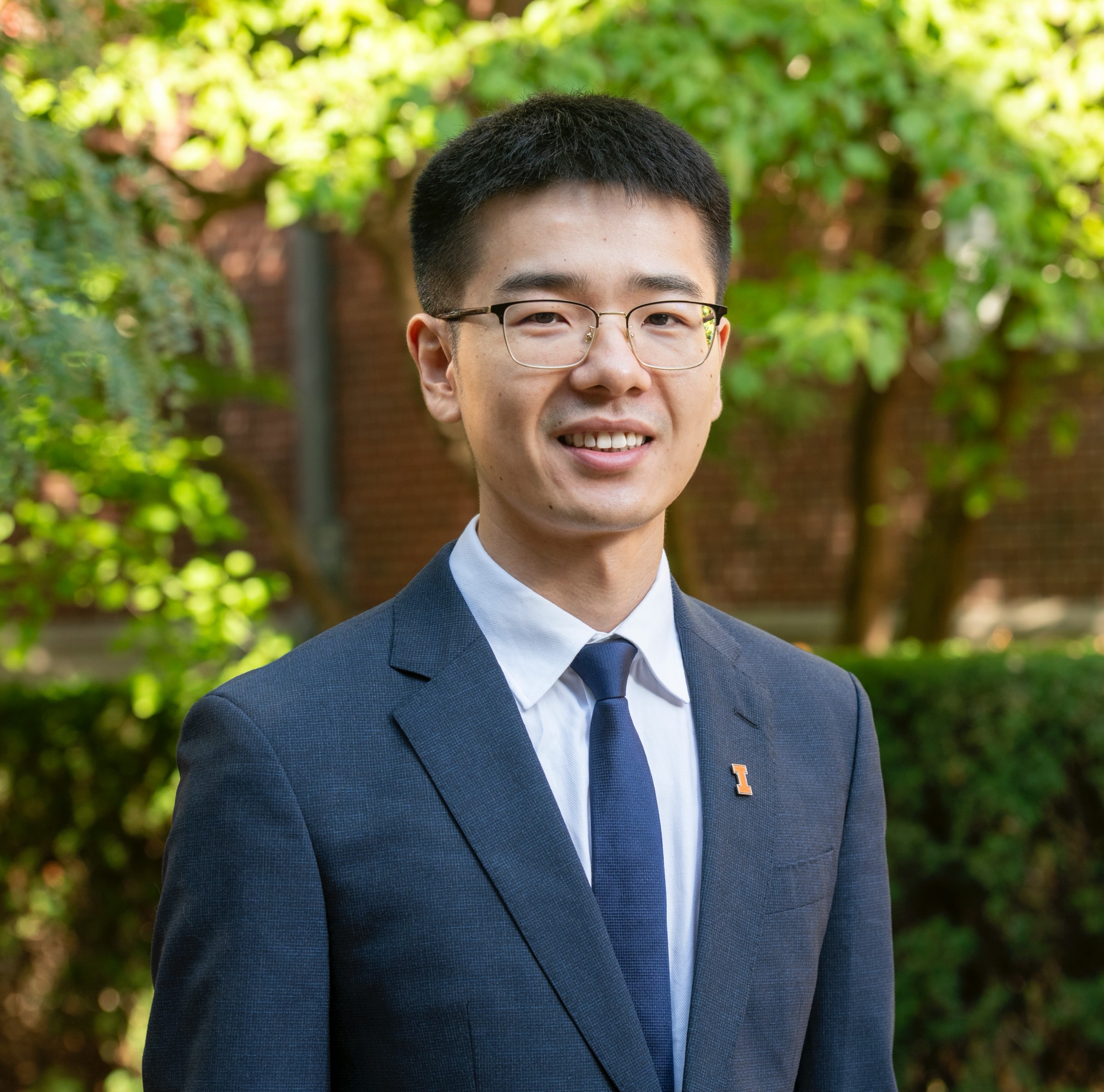
Assistant Professor of Business Administration

Yang Gao

University of Illinois Urbana-Champaign, Gies College of Business

I am an Assistant Professor of Business Administration at the Gies College of Business, University of Illinois Urbana-Champaign. I study how digital technologies shape information, platforms, and customer interactions, with a focus on misinformation, artificial intelligence, and customer service. Before joining Gies in 2023, I was an Assistant Professor of Information Systems at Singapore Management University. I earned my Ph.D. in Business Administration from the University of Rochester in 2021.

Yang Gao

Research

Artificial Intelligence

How social bots and social AI agents shape online user engagement.

Maggie Mengqing Zhang, Yang Gao, Jingjing Li, Steven L. Johnson. Forthcoming at Information Systems Research.

Abstract

As social media platforms deploy LLM-powered agents to help influencers manage social relationships with users, it remains unclear how this delegation impacts user engagement. Automating interactions provides scalability and efficiency for influencers, but it may weaken the influencer-user relationship if the agents fail to serve as effective social delegates. To explore this question, we empirically investigate the impact on user engagement when influencers delegate social interaction tasks, such as replying to comments, to a Social AI Agent, an LLM-powered proxy that responds on behalf of an influencer. Leveraging the rollout of a Social AI Agent feature on a major social media platform, we use a staggered difference-in-differences design to compare engagement behaviors between users who received an AI reply (i.e., a reply from an influencer’s Social AI Agent) and those who did not. Our results show that receiving an AI reply significantly increases user commenting on subsequent influencer posts, particularly when AI replies amplify an influencer’s social presence, as reflected in content relevance, stylistic alignment, and reply timeliness. We also find heterogeneous effects based on influencer-user relationships: engagement gains are stronger among loyal followers but weaker for commercialized influencers and those in the technology domain. Additionally, reply scarcity amplifies the effect: engagement increases more when influencers rarely replied previously or when fewer AI replies appear under the focal post. The engagement boost extends to both sponsored and non-sponsored posts as well as user reposting behavior, while influencers themselves also post more frequently after adopting AI agents. This study contributes to the literature on AI delegation and influencer engagement by highlighting when and how delegating social relationship management to Social AI Agents can enhance user engagement.

Paper
Media

Yang Gao, Maggie Mengqing Zhang, Mikhail Lysyakov. Information Systems Research, 37(1), 416-433, 2026.

Abstract

Leveraging advancements in large language models, social media platforms are increasingly deploying sophisticated chatbots, termed social bots, with the potential to stimulate user interaction. However, concerns linger regarding the socializing value of these bots in public settings. We investigate this phenomenon using data from the launch of CommentRobot on a microblogging platform. Analyzing user interactions with this platform-owned bot, we find that posts receiving bot-generated comments experience increased user engagement, demonstrating the socializing value of social bots at the post level. Results from an online experiment confirm this finding and reveal that the socializing value stems from both bot identity and high-quality content. Mechanism tests suggest that the quality of bot-generated comments—particularly their attractiveness, relevance, and inclusion of social cues—significantly influences user engagement. Moreover, we evaluate existing bot targeting strategies and propose policy learning-based improvements to optimize engagement. Despite the positive impact on post-level engagement, we find that receiving bot comments primarily encourages future bot-related posts rather than increasing overall user posting activity, contrary to platform expectations. Theoretically, this study contributes to the literature on social bots and the “Computers are Social Actors” framework by empirically examining relevant constructs in a novel context. Practically, our findings highlight the need for platforms to refine social bot deployment strategies to maximize user engagement while mitigating unintended consequences.

Paper

Misinformation

Crowd-based fact-checking on social media.

Yang Gao, Maggie Mengqing Zhang, Huaxia Rui. Forthcoming at Information Systems Research.

Abstract

To battle against rampant misinformation on social media, many platforms are experimenting with crowdsourced fact-checking—systems that rely on social media users’ annotations of potentially misleading content. This paper investigates the efficacy of such systems in curbing misinformation in the context of Community Notes, a pioneering crowdsourced fact-checking system from Twitter/X. Utilizing a regression discontinuity design, we empirically identified the positive effect of publicly displaying community notes on an author’s voluntary retraction of the noted tweet, demonstrating the viability of crowdsourced fact-checking as an alternative to professional fact-checking and forcible content removal. Our findings reveal that the effect is primarily driven by the author’s reputational concern and perceived social pressure, and there is considerable heterogeneity of such effect depending on specific tweet- and user-level characteristics. Platforms, therefore, can exploit the underlying mechanism and explore the use of contextual factors to harness the full potential of crowdsourced fact-checking. Furthermore, results from discrete-time survival analyses show that publicly displaying community notes not only increases the probability of tweet retractions but also, accelerates the retraction process among retracted tweets, thereby improving platforms’ responsiveness to curb misinformation. This study offers important insights to both social media platforms and policymakers on the promise of crowdsourced fact-checking and calls for the broad participation of social media users to collectively tackle the problem of misinformation.

Paper

Customer Voices

How to manage customer voices on social media.

Yang Gao, Junyuan Ke, Huaxia Rui, Shujing Sun. Forthcoming at MIS Quarterly.

Abstract

Understanding the role of gender in business interactions is of significant importance to companies and society. Inspired by practical concerns of how agent gender might affect customer service interactions, the present study investigates this question using a unique dataset consisting of all public customer service interactions handled by Southwest Airlines’ Twitter account from March 2018 to September 2019. Leveraging the online text-based customer service setting where an agent’s first name serves as the only gender cue, we are able to identify the gender effect on customer behaviors and service outcomes. The identification relies on two unique features of the research context: the assignment of a customer to the next available agent is independent of agent gender; and there is no significant variation, especially gender-induced differences, in an agent’s first response. Both assumptions are supported by the data. Empirical analyses reveal that customers are more likely to continue interactions with female agents than with male agents, yet are more negative in valence of their second tweet towards female agents. Mediation tests further show that customer gender bias in their second tweets leads to downstream effects on service outcomes: interactions with female agents tend to be longer but result in lower resolution rates. Moreover, the treatment effects are moderated by customer personality and public visibility. These results offer valuable lessons to practitioners and academics regarding the unique role of gender in online customer service.

Yang Gao, Huaxia Rui, Shujing Sun. MIS Quarterly, 47(3), 983-1014, 2023.

Abstract

Text-based customer service is emerging as an important channel through which companies can assist customers. However, the use of few identity cues may cause customers to feel limited social presence and even suspect the human identity of agents, especially in the current age of advanced algorithms. Does such a lack of social presence affect service interactions? We studied this timely question by evaluating the impact of customers’ perceived social presence on service outcomes and customers’ attitudes toward agents. Our identification strategy hinged on Southwest Airlines’ sudden requirement to include a first name in response to service requests on Twitter, which enhanced customers’ perceived level of social presence. This change led customers to become more willing to engage and more likely to reach a resolution upon engagement. We further conducted a randomized experiment to understand the underlying mechanisms. We found that the effects were mainly driven by customers who were ex ante uncertain or suspicious about the human identity of agents, and the presence of identity cues improved service outcomes by enhancing customers’ perceived levels of trust and empathy. Additionally, we found no evidence of elevated verbal aggression from customers toward agents with identity cues, although a mechanism test revealed the moderating role of customers’ emotional states. Our study highlights the importance of social presence in text-based customer service and suggests a readily available and almost costless strategy for firms: signal humanization through identity cues.

Yang Gao, Wenjing (Wendy) Duan, Huaxia Rui. Information Systems Research, 33(3), 954-977, 2022.

Abstract

Social media has become a vital platform for voicing product-related experiences that may not only reveal product defects, but also impose pressure on firms to act more promptly than before. This study scrutinizes the rarely studied relationship between these voices and the speed of product recalls in the context of the pharmaceutical industry in which social media pharmacovigilance is becoming increasingly important for the detection of drug safety signals. Using Federal Drug Administration drug enforcement reports and social media data crawled from online forums and Twitter, we investigate whether social media can accelerate the product recall process in the context of drug recalls. Results based on discrete-time survival analyses suggest that more adverse drug reaction discussions on social media lead to a higher hazard rate of the drug being recalled and, thus, a shorter time to recall. To better understand the underlying mechanism, we propose the information effect, which captures how extracting information from social media helps detect more signals and mine signals faster to accelerate product recalls, and the publicity effect, which captures how firms and government agencies are pressured by public concerns to initiate speedy recalls. Estimation results from two mechanism tests support the existence of these conceptualized channels underlying the acceleration hypothesis of social media. This study offers new insights for firms and policymakers concerning the power of social media and its influence on product recalls.

Paper
Award
Best Paper in Track Award, ICIS 2021.

Shujing Sun, Yang Gao, Huaxia Rui. Journal of Management Information Systems, 38(3), 579-611, 2021.

Abstract

Despite many advantages of social media as a customer service channel, there is a concern that active service intervention encourages excessive service complaints. Our paper casts doubt on this misconception by examining the dynamics between social media customer complaints and brand service interventions. We find service interventions indeed cause more complaints, yet this increase is driven by service awareness rather than chronic complaining. Due to the publicity and connectivity of social media, customers learn about the new service channel by observing customer service delivery to others—a mechanism that is unique to social media customer service and does not exist for traditional call centers. Importantly, high-quality service reduces future complaints. As a result, proactive customer service is a sound strategy on social media, as long as firms dedicate to service quality. Hence, firms should be less concerned about whether to respond and more focused on how to respond to customer complaints.

Paper

Others

Related work on empirical methods.

Yang Gao, Meng Li, Shujing Sun. Journal of Operations Management, 69(4), 676-701, 2023.

Abstract

While the field experiment is a powerful and well-established method to investigate causal relationships, operations management (OM) has embraced this methodology only in recent years. This paper provides a comprehensive review of the existing OM literature leveraging field experiments. It also serves as a one-stop guide for future application of field experiments in the OM area. We start by recapping the characteristics that distinguish field experiments from other common types of experiments and organizing the relevant OM studies by topic. Corresponding to the commonly overlooked issues in field experimentbased OM studies, we then provide a detailed roadmap, ranging from experimental design and implementation to post-experiment analysis. We further outline the methodological and practical issues as well as corresponding solutions when applying field experiments. We conclude by identifying future research directions from an OM perspective.

Paper
Recognition
Top Cited Article in Journal of Operations Management, 2023.